Saturday, March 24, 2012

How the Garcia Girls Lost Their Accents

Synopsis
The four Garcia sisters come to terms with their Dominican roots, their lives in America, and their emerging feminism.


My thoughts
I was really looking forward to reading this book. To be honest, I didn't enjoy it as much as I thought I would. The book would work well if it were just a series of standalone essays. But it tries to be more than that and falls short. Because the book goes in reverse chronological order, there is no resolution to many of the questions raised at the beginning, so it feels incomplete.

But I still have many positive things to say about the book. The girls all have distinct, strong, often conflicting personalities. The depiction of sibling rivalry is pitch perfect and the various crises the sisters face are entertaining to read and easy to relate to. The stories move along quickly, so it doesn't take long to become engrossed in them. (This was a huge plus for me—I read the book while I was visiting family and needed something I could pick up and read during the short gaps between family obligations.) The narrative shifts back and forth between the sisters, giving you a panoramic view of the younger generation's experiences and opinions. It makes you feel like you're friends with each of them, so you're privy to their personal insecurities and internecine squabbles.

There are various levels of culture clash—the older generation's difficult adjustment, the younger generation's intolerance of their parents' backwardness. Alvarez does a particularly good job describing the sisters' sense of homelessness, their inability to feel entirely at home as Americans or Dominicans and their struggles to define and own (with varying degrees of success) their identities as dual citizens. Her firsthand experience is apparent here.

Bottom line
The vignettes are resonant and highly personal, but don't expect a cohesive narrative or a sense of closure.

Fine print
How the Garcia Girls Lost Their Accents, by Julia Alvarez
Genre: Fiction
Photo from Goodreads
I borrowed this book from the library

Friday, March 23, 2012

The Invisible Bridge

Synopsis
Andras Lévi, a Hungarian Jewish student, leaves Budapest for Paris to study architecture. The future looks bright—he's a talented architect and he's fallen in love. But it's 1937.

My thoughts
I don't think a book's acknowledgments have ever made me cry. But Orringer's acknowledgments are a reminder that the best works of fiction have their roots in reality. It's impossible to know which of the book's events are inspired by truth and which sprang from Orringer's imagination, but she has managed to weave them together to create a moving account of a chapter of World War II that too few people know anything about.


Hungary's role in World War II is often overlooked, but it was an anomaly. (Hungary itself—a Magyar nation separating the northern Slavs from their southern brethren—has always been an anomaly too.) Hungary was formally aligned with Germany and Italy, but it entered the war reluctantly. The Nazis reacted with hostility to the Hungarian government's attempts to broker independent peace treaties with the Allies. They occupied the country and installed a puppet regime in 1944. Until then, the Hungarian government had resisted pressure from the Nazis to send its Jewish citizens to concentration camps. (That's not to say everything had been rosy for Hungary's Jewish citizens; they still faced persecution and discrimination, saw their rights stripped from them over the course of the war, and were forced to do menial labor for the armed services.) But the Nazi takeover was devastating. According to the U.S. Holocaust Memorial Museum, more than two-thirds of Hungary's Jewish citizens died between March 1944 and the end of the war a little more than a year later. Today, Budapest has the most haunting Holocaust memorial I've ever seen. Near the Parliament building, dozens of pairs of empty bronze shoes lie abandoned in one long row along the banks of the Danube.

I was attracted to this book because of the history, but the strength of the book lies in the characters and their relationships with one another.

In Andras, Orringer perfectly captures the passion and potential, the naivete and optimism of a young man coming into his own despite the looming threat of war. The heart of the story is Andras's underdog love story. He becomes enchanted with the beautiful Klara Morgenstern, an alluring Hungarian mysteriously exiled to Paris to teach ballet lessons to support herself and her teenage daughter. There are shades of Moulin Rouge as she improbably falls for the penniless artiste, but I love a good love story and I loved rooting for them. Because of the complex backstory and complicating current events, their relationship is by no means a sure thing.

Orringer also takes the time to flesh out the supporting characters, particular Andras's brothers and the architecture student Polaner. All of them have compelling stories of their own and I grew attached to all of them despite my best efforts not to. (In a book like this, you know not everyone will live happily ever after, so the fewer characters you're invested in, the better your emotional state when it ends. At least that's the way it is for me.)

As the book (and the war) progress, Orringer wisely refrains from trying to describe too much. The tack she takes—sparingly depicting Andras's growing hopelessness—is much more effective. She even conveys Andras's weakening physical and mental state by cutting down the narration so that at times there are only sentence fragments.

Without giving away too much, the last chapters of the book are bittersweet. I renewed the book once and then kept it for as long as I could. I finished it at the library, sitting in a beautiful courtyard on an unseasonably warm December day. It was fitting that as I read the last few pages, one of the library's event coordinators was walking a prospective bride through the garden and helping her envision where the chuppah would stand.

Bottom line
One of the best books I read in 2011. We need books like this, books that vividly bring to life the truly shocking inhumanity of the Holocaust and other genocides.

Fine print
The Invisible Bridge, by Julie Orringer
Genre: Historical fiction
Photo from Goodreads
I borrowed this book from the library. Then I bought it.

Sunday, January 22, 2012

The Last Spymaster

Synopsis
Disgraced CIA agent Elaine Cunningham is called back into the field to track down Jay Tice, a traitor who has escaped from prison.

My thoughts
This made for an enjoyable, entertaining thriller. Lynds kept the action moving and threw in plenty of twists to keep me on my toes.

Cunningham makes a competent, compelling female lead (and I love that she drives a red Jag). The mystery surrounding Tice—a former high-ranking CIA operative who went to jail after admitting he'd betrayed his country—elevates an already intricate plot. I was a little worried at the outset because it seemed inevitable that these two would fall into a cliched May–December affair, and I was gratified that Lynds resisted this and even added a complex romantic backstory for each of them.

Lynds takes her time laying the groundwork for the plot, but even the slowish beginning held my attention and the payoff in the last chapters is immensely rewarding. She reveals each character's layers and motivations with precise timing so the pieces fall into place at just the right time. Lynds also has a talent for writing taut, nail-biting action sequences.

My sole issue with this book was the identity of the mysterious Moses character. He would have behaved entirely differently when he was first introduced—but then that would have ruined the entire book.

Bottom line
Good sick day read.

Fine print
The Last Spymaster, by Gayle Lynds
Genre: Thriller
Photo from Goodreads
I borrowed this book from the library

Saturday, January 21, 2012

Redwall

Synopsis
The peaceful abbey of Redwall comes under threat from the fearsome Cluny the Scourge. Redwall's only hope may be young Matthias, a brave but inexperienced novice.

My thoughts
I had high hopes for this book because my brother devoured the series when we were kids. (Incidentally, this is the only way he reads—he rarely reads, but when he finds something he likes he doesn't come up for air until he's done.)

But. I just couldn't get into it. First, I'm not sold on the woodland creatures and their human-like civilization. Second, I couldn't connect with Matthias and his friends.

It probably didn't help that I dove into this book immediately after finishing Harry Potter and the Prisoner of Azkaban, which highlighted Redwall's shortcomings. Redwall's plot seemed too simplistic. Matthias had a mission—to find the sword of Martin, the great warrior mouse—but there was never any suspense. I knew Matthias would encounter obstacles, but I knew he'd get past them. Matthias was meant to triumph because Matthias represented Good. The divide between Good and Evil in Redwall is comically cartoonish—the bad guys are pure evil and the good guys are righteous. Because of that, there was no character growth, no redemption, nothing that would make the storyline surprising or entertaining.

Finally, one minor quibble: old-fashioned gender stereotypes are in full force here. Matthias goes off on his quest while his underdeveloped potential love interest Cornflower packs some snacks for him and helps out in the kitchen. There is a brave female squirrel, a formidable female badger, and a sparrow queen who unites her clan—but none of them captures the heart of the hero. I guess that's what bothered me—the pervasive fiction that you get the guy by being pretty and demure (although I suppose being the same species helps somewhat in this world).

Bottom line
I won't be moving on to Mossflower or any of the other books in the series.

Fine print
Redwall, by Brian Jacques
Genre: Young adult fantasy/adventure
Photo from Goodreads
I bought this book at a local library book sale

Thursday, January 19, 2012

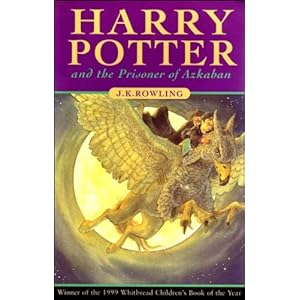
Harry Potter and the Prisoner of Azkaban

Synopsis
Book 3 in the Potter saga finds 13-year-old Harry plunged into greater danger than ever before. A mass murderer has escaped from the Alcatraz of the wizarding world and everyone is convinced he's on his way to Hogwarts to kill Harry.


My thoughts
This is my favorite and arguably the strongest of the Harry Potter series. The first two were fun to read, but this is the one that hooked me. It's nearly perfect—the friendships are well drawn, the humor is biting, and the action is perfectly paced. There are so many great little details and they all build to one of the best resolutions to any book I've ever read. Even though I've lost count of the number of times I've read it, I still have to block off a couple hours so I can read straight through the last hundred pages.

Azkaban introduces two of Rowling's most brilliant additions to Harry's world—the dementors and the Marauder's Map. The dementors are ingenious because of their stark simplicity. Rowling took the crushing despair of depression and made it literal, tangible, relatable—and terrifying. As for the Marauder's Map, I would like something similar to point out speed traps on the highway. (Who wouldn't?) But that's only half the reason I love it. Azkaban is full of reveals concerning Harry's parents and their friends from Hogwarts, and tying the Marauder's Map into that backstory was a truly nice touch. (Side note: The way Rowling manages to seamlessly blend her creations with existing mythological creatures and concepts is nothing short of magical. It's a real talent. Other authors take you out of the action while they beat you over the head with all the research they've done. Rowling has enough faith in her readers to trust them to keep up with her storytelling.)

Bottom line
I dare you to read this book and not fall completely in love with the Harry Potter series. If you can ... I'm not sure what that says about you, but it's not good.

Fine print
Harry Potter and the Prisoner of Azkaban, by J.K. Rowling
Genre: YA fiction
Photo from Amazon UK
I bought this book (three times—I lent the first copy to a friend and the dog used the second one as a chew toy)

Tuesday, December 20, 2011

Library Loot—December 14-20

Library Loot is a weekly event co-hosted by Claire from The Captive Reader and Marg from The Adventures of an Intrepid Reader that encourages bloggers to share the books they’ve checked out from the library. If you’d like to participate, just write up your post-feel free to steal the button-and link it using the Mr. Linky any time during the week. And of course check out what other participants are getting from their libraries!

It's been a month since I've been to the library, but I'm back with a vengeance. I'm leaving to go home for Christmas tomorrow, so I need a ton of books to get me through 10 days and two 12-hour car rides. I know this is why ebooks were created, but I can't bring myself to read everything off of a soulless screen.

Anyway, here's what I've picked up:

The Last Spymaster, by Gayle Lynds. It's an espionage thriller and I'm thrilled that it's written by a woman. Disgraced CIA operative Elaine Cunningham is brought back from limbo to find Jay Tice, a Cold War spy who has broken out of prison. Shouldn't be too much trouble for a seasoned hunter like Cunningham. Oh, except that Tice was a legendary operative himself. And the situation turns out to be much more complicated than it first appeared (naturally).

One Hundred Years of Solitude, by Gabriel Garcia Marquez. This is another classic that I've somehow never read. It's a sprawling multigenerational epic and I'm eager to jump in. These types of books inspire passionate hatred in some readers and equally passionate appreciation from rest—there doesn't appear to be a middle ground. I don't expect this to be one of the books I keep on my shelf and lovingly reread on rainy days, but I hope I'll enjoy it.

How the Garcia Girls Lost Their Accents, by Julia Alvarez. I love the idea of this book—a quartet of sisters caught between two cultures struggle to define their identities.

The Makioka Sisters, by Junichiro Tanizaki. Four sisters struggle to define their identities amid the shifting landscape of pre-WWII Osaka. My love for sister stories started with Little Women and The Makioka Sisters is considered a modern classic.

That's it for my library loot, but I'm packing a few other books for the ride. First, Anchee Min's Empress Orchid, which tells the story of a concubine in the Forbidden City during the tumultuous mid-nineteenth century. I read one of Min's earlier books, Wild Ginger, earlier this year and wasn't overly impressed. Part of it had to do with fact that the subject matter—the Cultural Revolution—is much more powerful when it's presented in a memoir like Wild Swans. I don't know as much about imperial China, so I'm hoping that will make this book more interesting. Second, I'm also bringing Donna Napoli's Beast, a retelling of the Beauty and the Beast story set in Persia.

And just to make my bag a little heavier, I'm taking Operation Mincemeat and Flyboys, which I think my parents will enjoy as much as I did, and John Adams and A Christmas Carol, which I borrowed from them last year.

Finally, an update on my last Library Loot post: I'm still reading The Invisible Bridge. It's due tomorrow (and I've already renewed it once), and I'm thisclose to finishing it. I love all of it—the characters, the story, the storytelling—everything. But. I'm fifty pages from the end and as much as I want Raoul Wallenberg to materialize with his magical Swedish papers, I don't think there's enough time for a heroic, happy ending. But I can still hope. And that's why I haven't finished the book yet.

Friday, November 11, 2011

The Woods

Synopsis
Essex County prosecutor Paul Copeland has a lot going on. He's prosecuting a rape case against a couple of privileged frat boys (think the Duke lacrosse scandal). He's a single father with a six-year-old daughter. He's also haunted by the twenty-year-old case of the disappearance and presumed murder of his sister at summer camp (in the titular woods). When another supposed victim of the summer camp murders turns up dead in the present day, Copeland starts to wonder whether his sister might still be alive and whether all of his assumptions about that case might be wrong.

My thoughts
I love these page-turner mysteries, but I have to force myself to take some time off between them; otherwise, they get too predictable and pat. I got this one for a plane ride and fell right into it.

This was my first Coben read, and there was more than enough in the plot to keep me entertained. I guessed some of the twists, but there were so many that I was pleasantly surprised more than a few times. If I have a complaint it's that maybe there's too much stuffed into one book. There are about half a dozen minor mysteries in addition to the main one (whether Copeland's sister was really murdered all those years ago). Seemingly extraneous details such as Copeland's grandfather's involvement with the KGB turn out to be completely relevant.

Bottom line
Read it when you have a few hours with nothing to interrupt you.

Fine print
The Woods, by Harlan Coben
Genre: Mystery
Photo from Goodreads
I borrowed this book from the library