Friday, June 12, 2015

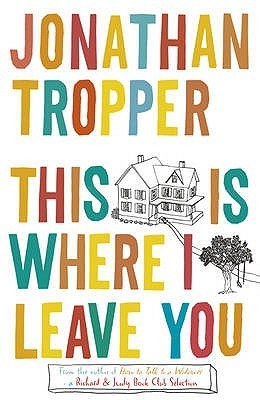
This Is Where I Leave You

Synopsis
A dysfunctional family sits shiva for their patriarch. Hilarity ensues.

My thoughts
"Read it—or take it as a gift—when you next go on a dreaded family vacation," says the Washington Post review of This Is Where I Leave You. So that's what my brother did—even though our family vacations are anything but dreaded. We teased him mercilessly about it, and then his fiance read it and then I read it and my brother never even got to crack it open. It's quick and enjoyable and it kept me entertained right through the end.

"'Dad's dead,' Wendy says offhandedly, like it's happened before, like it happens every day." That's how the book begins, and it's typical of Jonathan Tropper's easy, conversational style. It's like the cute slacker boy you went to high school with—casually provocative, keenly observant, and slyly witty. One of his funniest lines concerned toddlers in what he termed the "E.T. stage"—when they shuffle around banging into things and muttering unintelligibly to themselves. (One of my friends calls it the Milton-from-Office-Space phase, and they're both hilariously accurate descriptions.) Tropper specializes in over-the-top guy humor and slapstick comedy. It works well, but his constant quest to one-up himself culminates in an unsatisfying ending. It gets to be too much and the story kind of gets away from him.

The Foxman family, the quirky group at the center of the book, is endearing if not relatable. The only sibling who isn't fully realized is Wendy, the sister. I was shocked that Tina Fey signed on to play such a stereotypical one-dimensional harpy in the film adaptation. I haven't seen the whole movie, but I hope they gave her more to do than Tropper did in the book.

One of my friends let me borrow her copy of How to Date a Widower, which I liked better than This Is Where I Leave You, and I snagged another Tropper book from the same friend's bookshelf when she was cleaning it out so I'll definitely read more of his stuff.

Bottom line
Definitely worth a read. But see Death at a Funeral (either the British or American version) instead of the mediocre film adaptation.

Fine print
This Is Where I Leave You, by Jonathan Tropper
Genre: comedy, fiction
Similar authors: Tom Perrotta, Nick Hornby, Helen Fielding, Sophie Kinsella
Photo from Goodreads
I borrowed this book from my brother

Monday, January 19, 2015

The Postmistress

Synopsis
The intertwined stories of three American women during World War II.

My thoughts
Frankie Bard is an American broadcaster reporting from London during the Blitz. Her stories bring the war into the sleepy Cape Cod living rooms of postmistress Iris James and newlywed Emma Fitch. Frankie's story is haunting, especially when she travels to the continent and connects with Jews who are desperate to leave. But then she returns to the United States and the action grinds to a halt. In the meantime, Iris and Emma's storylines have progressed at the speed of molasses before getting completely stuck. Once Frankie connects with the other two I decided I was just about done with the book. They just sucked the life out of her storyline.

I always looked forward to Frankie's chapters because they were such a relief after the tedium of Iris and Emma's. Sarah Blake's writing comes alive when she writes from Frankie's perspective and it's noticeably more awkward when she uses Iris and Emma's voices. Blake's writing is beautiful, but it's not effortless and that makes it distracting.

Sarah Blake worked hard to make everything come together seamlessly at the end. But the drama felt manufactured and then it fizzled into two huge narrative copouts. Instead of the confrontations I'd been promised, I came away absolutely empty.

Bottom line
Not recommended. Read Frankie's chapters and skip the others (or skip the entire book).

Fine print
The Postmistress, by Sarah Blake
Genre: historical fiction
Photo from Goodreads
I borrowed this book from my library.

Tuesday, January 13, 2015

The Red Queen

Synopsis
Fanatically religious Margaret Beaufort makes it her life's mission to see her son become king of England during the Wars of the Roses in one installment of Philippa Gregory's mesmerizing "The Cousins' War" series.

My thoughts
"The Cousins' War" loses some of its allure, all because Margaret Beaufort is supremely unsympathetic. Even in Philippa Gregory's capable hands, Margaret's religious asceticism is dull as dirt.

Margaret Beaufort was the polar opposite of those lusty, fertile Woodvilles, and as a Lancastrian she was pitted against them in the Wars of the Roses. She was the mother of Henry Tudor, who would grow up to defeat Richard III to become king of England as Henry VII. She had already been widowed when she gave birth to Henry at the age of thirteen (say it with me: good God!). She was a very devout Catholic who believed it was God's will that her only child succeed to the throne of England.

If there's one weakness in "The Cousins' War" series, it's that the books overlap so much. While it can be interesting to see the same event from opposing perspectives, it's ultimately too repetitive.

I didn't care for this book, but I did like Margaret Beaufort in the Starz miniseries The White Queen (which was based on Gregory's book series), mostly because of Amanda Hale's marvelously twitchy performance. Now on to the final two books in the series (Gregory is nothing if not prolific)!

Bottom line
"The Cousins' War" is worth reading, but you won't miss much if you skip this one or just watch the miniseries.

"The Cousins' War" Reviews
The White Queen
The Lady of the Rivers
The Kingmaker's Daughter

Fine print
The Red Queen, by Philippa Gregory
Genre: historical fiction
Photo from Goodreads
I own this book.

Friday, January 9, 2015

Divergent

Synopsis
Another book about teens in a dystopian society with a PG love story.

My thoughts
For YA dystopian fiction, there's Lois Lowry's The Giver and then there's everything else. Nothing will ever top The Giver, but reading books like Divergent is an irresistible guilty pleasure for me. The key is to erase all your expectations and suspend disbelief.

The setting is a vaguely futuristic Chicago. There's been some sort of minor apocalypse, and the city has been walled in and society has been reordered into factions that can theoretically coexist in harmony. Except ... not so much with the harmony. Or the coexistence.

What Divergent has going for it is a feisty heroine and a lot of page-turning action. There's a tame romance with a guy with a predictably mysterious past thrown in for good measure. It's a fun, mindless read and I'll probably pick up the next book in the trilogy at some point.

Bottom line
Read the book, skip the movie (yeah, that's right—I watched the movie, too).

Fine print
Divergent, by Veronica Roth
Genre: YA, science fiction
Photo from Goodreads
I borrowed this book from a friend.

Thursday, December 18, 2014

People of the Book

Synopsis
Creates a fictional history for the real-life Sarajevo haggadah.

My thoughts
I've wanted to read anything by Geraldine Brooks for a while. Her books are always well reviewed, and she writes about an appealingly diverse array of subjects.

For People of the Book, Brooks uses historical records of the Sarajevo haggadah as the scaffolding for her story (detailed in an article she wrote for The New Yorker in 2007) and then uses her imagination and formidable storytelling powers to fill in the blanks. The haggadah, which tells the story of the Jews' exodus from Egypt, has an extraordinary history. It was created in Spain and survived Ferdinand and Isabella's expulsion of the Jews in 1492. In 1609 a Catholic priest in Venice spared the haggadah from destruction in the Pope's Inquisition. And in 1894, the haggadah arrived in Vienna for conservation (which actually did more damage than anything else). During World War II, a Muslim librarian at the Bosnian National Museum risked his life to keep the book out of the Nazis' hands. The book was saved by another Muslim librarian during the civil war that tore through the Balkans in the 1990s. Brooks fictionalizes all of these historical events and strings them together with a present-day narrative in which an Australian rare book specialist is hired to preserve the haggadah. She finds salt, wine stains, hair, an insect wing on or within the pages of the haggadah, and Brooks uses these to flash back to various points in the book's past.  

People of the Book is a testament to what Sarajevo used to be before Nazism, communism, and civil war. It was a modern city where  Jews, Muslims, and Christians coexisted. It's also a timely reminder that all three religions share the same roots. And it's a book that celebrates the good in humanity in times of evil and oppression; one of the most remarkable things about the haggadah is that it survived. Many people risked their lives or their livelihoods to guard the book throughout the centuries.

My town just selected Caleb's Crossing for its 2015 One Book One Town program and I picked up a copy of Nine Parts of Desire from my library's used book sale, so I have plenty more Geraldine Brooks to look forward to.

Bottom line
Worth a reread in a few years.

Fine print
People of the Book, by Geraldine Brooks
Genre: historical fiction
Photo from Goodreads
I bought this book.

Thursday, November 27, 2014

True Compass

Synopsis
Ted Kennedy's memoir. Speaks for itself.

My thoughts
I voted for Ted Kennedy once, shortly after I moved to Massachusetts. It's a mark of how popular he was that I didn't even know he was up for reelection until I got to the polling place and saw a campaign sign.  So I was interested to read more about him in his own words.

I generally stay away from books written by politicians because they're often more interested in laying out an agenda than anything else. I thought I'd be safe with a memoir written by a politician who knew he was dying and so couldn't run for office again. I was kind of right but kind of not. Kennedy does his best to spin events  like the tragedy at Chappaquiddick and his ill-fated 1980 presidential run. However, he does better explaining the cheating scandal at Harvard and how it forced him to grow up.

One characteristic I did admire was his ability to deal with harsh situations without self-pity. Life wasn't always kind to Kennedy. All three of his brothers died young and violently. Two of his children survived cancer, and he readied the book for publication knowing he was dying. But he plunged through life with a spirit of perseverance.

Kennedy's memoir is also an indictment of modern Washington politics. He was a master politician and he understood that you had to compromise to make things happen. And he did accomplish a lot in nearly five decades as a legislator. His fight for health care reform spans the book and he did not live to see the most recent iteration signed into law. In his memoir he candidly addressed the advantage of being born into a monied family and the responsibility he felt to fight for others who weren't as fortunate. His persistence in reforming the health care system bit by bit is a perfect example of that sense of responsibility in action.

Bottom line
Made me want to vote for him again.

Fine print
True Compass, by Edward M. Kennedy
Genre: politics, memoir
Photo from Goodreads
I borrowed this book from my library on my Kindle.

Monday, October 20, 2014

Queen Isabella

Synopsis
A biography of the extraordinary life of Isabella of France, who deposed and later possibly murdered her husband, England's Edward II.

My thoughts
Isabella was the lovely French princess who was sent to negotiate with William Wallace and ultimately fell in love with him in the blockbuster Braveheart. Unfortunately, that aspect of the movie was completely fictitious. Fortunately, Isabella's real life was even more dramatic (and much less cliched).

Isabella, the treacherous "she-wolf of France," is one of the most notorious and vilified figures in English history. Weir rightly calls this out as misogyny. A man who reacted as Isabella did would have been remembered as a righteous victor, but because Isabella was a woman who challenged her husband and king, history has been particularly unkind to her. Weir also points out that Edward II, far from being the spineless wimp from Braveheart, was actually a courageous military leader.

Isabella arrived in England from France at the age of 12 to cement a fragile peace between the two countries by marrying the future Edward II. Edward was a weak king who was easily controlled by his favorites, creating a toxic culture in the English court. Isabella allied herself with a faction that opposed Edward's favorite and lover Hugh Despenser, and she began to fear for her safety. Under the guise of a diplomatic mission, she returned to France, where she began to plot to overthrow Edward II in favor of their son, another Edward. With money and men from France, Isabella returned to England and successfully installed Edward III on the throne. She and Roger Mortimer, her co-conspirator and lover, were the powers behind the king. But when Edward III came into his own, he began to resent Isabella and Mortimer. He asserted his power and sent his mother into exile in the English countryside. As for Edward II, he lived as a prisoner in relative comfort until he was murdered, allegedly at Isabella's request or at least with her advance knowledge.

... Or was he? Weir argues that Edward II escaped to mainland Europe, lived out his life as a hermit, and even forgave Isabella and Edward III. So everyone lived happily ever after. Weir cites one letter as proof, but much of her case seems to be based on educated guesses and wishful thinking. She's had some success writing historical fiction and this twist would have been delightfully shocking in a novel, but there needs to be more evidence for a biography.

As with Eleanor of Aquitaine, Alison Weir does a marvelous job unearthing details of Isabella's life (always difficult with medieval queens because women didn't create much of a paper trail back then) and explaining what life was like in the fourteenth century. However, it can make for a very dry read at times as Weir catalogs the royal household's road trips, wardrobe expenditures, and grocery budgets.

Bottom line
Exceptional and enlightening. Definitely worth a read.

Fine print
Queen Isabella, by Alison Weir
Genre: history, non-fiction
Photo by Goodreads
I borrowed this book from my library.