Tuesday, July 8, 2014

Dreams from My Father

Synopsis
Written before he launched his political career, Barack Obama describes his early life in Hawaii and Indonesia, his college career, and his days as a community organizer in Chicago - all influenced by the dreams of the father he never really knew.

My thoughts
I'm generally leery of political biographies or books by politicians in general, but I was interested in Dreams from My Father because it was written before Obama was elected to public office. I figured that meant it wouldn't be skewed by a political agenda. I'm glad I read it because it's a very honest, thoughtful book about a young man finding his place in the world and confronting some of the most divisive aspects of life in the United States.

Obama had a unique childhood. He was born in Hawaii to a white American mother and a black Kenyan father. His parents divorced when he was young and his father pursued a doctorate at Harvard before returning to Kenya. His mother stayed in Hawaii before moving with her son to Indonesia. Obama returned to Hawaii to attend Punahou, the top private school in the state. From there he decided to attend Occidental College in California and pursued an office career for a while before he pursued his impulse to change the world by becoming a community organizer. Throughout his childhood and young adulthood, Obama struggled with his identity, and the book closes with his poignant trip to Kenya to visit his father's family.

It's an amazing journey, one that makes his subsequent career from community organizer to president of the United States almost mundane by comparison.

Bottom line
This is an important book to read if you want to learn more about Barack Obama, American race relations, or white colonialism in Africa.

Fine print
Dreams from My Father, by Barack Obama
Genre: memoir
Photo from Goodreads
I bought this book as a birthday present for myself ... in 2008 (and I just got around to reading it).

Tuesday, July 1, 2014

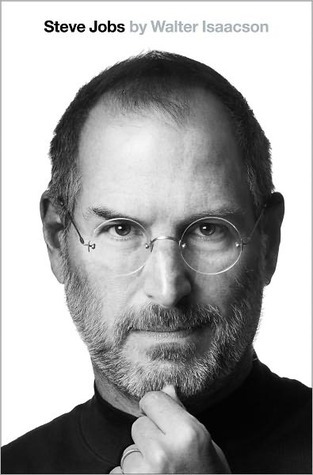
Steve Jobs

Synopsis
A thorough biography of Apple's mercurial co-founder, savior, and legend.

My thoughts
This biography was hugely entertaining and full of information. Not only did Steve Jobs live an epic life, but Walter Isaacson interviewed practically everyone Jobs ever met to research this book. Isaacson knows how to skillfully sift through all the gossip and other noise to present a well-rounded portrait of his subject. That said, he wasn't able to remain completely impartial. It's almost like he was in awe of Jobs (not that I blame him).

This is certainly a warts-and-all profile, and I came away with the impression that Jobs was a brilliant man but not someone I'd want to work for. He was stubborn, ambitious, and egotistical, and although those qualities translated into enormous success in the business world, they also pushed some of his co-workers and subordinates to the breaking point. It's ironic that these qualities also contributed to his early death. When Jobs was diagnosed with pancreatic cancer, he initially chose not to follow his doctors' advice. Defying authority and thumbing his nose at conventional advice had worked spectacularly in his professional life, but it had devastating consequences for his health.

One of the small pleasures of this book was that it gave me the thrill of discovering the inside story to many of the technological innovations that I take for granted. Jobs's magnetic personality inspired his subordinates and spurred them to come up with solutions to problems most people wouldn't even have realized existed. The revolutionary scrolling wheel on the first iPod was one such example. It's a relatively simple idea, but it elegantly streamlined the process of scrolling through a long list of songs on a small screen.

The book also made me appreciate Jobs's (and Apple's) dedication to aesthetics. He understood exactly what technology people wanted (a personal computer, a tablet computer, a multipurpose phone/music player/video game console), and he cared what it looked like. "It's in Apple's DNA that technology alone is not enough," he explained when he introduced the iPad 2. "It's technology married with liberal arts, married with the humanities, that yields us the results that make our hearts sing." Jobs could give people what they didn't even know they wanted because he had a passion for the entire product, not just one aspect of it. That's an incredibly rare trait.

Bottom line
Compulsively readable.

Fine print
Steve Jobs, by Walter Isaacson
Genre: biography
Photo from Goodreads
I borrowed this book from my library.

Monday, June 23, 2014

Where the Moon Isn't

Synopsis
The narrator, a young man named Matthew, struggles with schizophrenia and grapples with the long-ago death of his brother, for which Matthew feels responsible.

My thoughts
Matthew shares his experiences in a mostly irritating stream of consciousness. The stream-of-consciousness technique is brilliant when it's done right, but the problem here is that most of Matthew's stream of consciousness isn't very interesting. He's also self aware—but not in a good way. He has an annoying habit of going, "Well, I'm going to introduce you to this person and here are a bunch of inane details and this one thing will be important, but not for fifty pages." I hate it when authors try to build suspense by dropping hints and screaming at you to pay attention. It doesn't feel organic and disrupts the flow of the story.

The central hook of the novel is the death of Matthew's older brother, who had Down Syndrome. Simon died a decade ago and Matthew feels responsible. The answers to the questions "why?" and "what happened?" are strung out over several hundred pages, and there just isn't enough meat to the story to drag it out that long.

I was drawn to this book because the author is a mental health nurse and it was a highly regarded debut novel (you think I would've learned to be more cautious after my disappointing experience with Absolution). Between this and Sarah's Key I'm really starting to doubt my ability to pick a good book.

Bottom line
There have got to be better debut novels out there.

Fine print
Where the Moon Isn't, by Nathan Filer (interestingly, it's published as The Shock of the Fall in the UK, where Filer is from and the novel takes place)
Genre: fiction
Photo from Goodreads
I borrowed this book from the library.

Wednesday, May 28, 2014

Sarah's Key

Synopsis
In 1942, the Vichy government forces ten-year-old Sarah and her parents from their apartment in Paris. Before they leave, Sarah manages to hide her little brother in a cabinet. In present-day Paris, Julia Jarmond, a journalist with a personal tie to the apartment, uncovers Sarah's story.

My thoughts
I'd heard a lot of wonderful things about this novel, so I grabbed it when I saw it at my library's used book sale. Sarah's story is undeniably moving, but it's not enough to save this predictable novel.

First, the good. When we first meet her, Sarah is a happy girl and it is heartbreaking to see her innocence taken away so brutally. I'd defy anyone to read her part of the narrative without crying. Tatiana de Rosnay does a good job exposing the brutality of the Nazi-compliant Vichy regime. She also doesn't flinch from depicting the indifference of many non-Jewish French citizens. (In college, I read a book called The Vichy Syndrome, which described how postwar France strove to whitewash its past and envisioned itself a nation where everyone was involved in the Resistance and the Vichy government was run by an unpopular minority.)

And now for the not-so-good. The present-day narrative is atrocious. Julia is an indecisive emotional wreck who's married to a stereotypically sleek, skeezy, hypersexual French guy. Together they have a teenage daughter who acts as Julia's conscience, not a teenager. After years of trying to have a second child, forty-something Julia finds herself pregnant, which triggers her husband's midlife crisis. There's a lot of drama that feels incredibly trite, especially when you contrast it with the other half of this double narrative—a child in the Holocaust, for heaven's sake.

Unfortunately, as the novel goes on Julia's narrative takes over and Sarah's is lost. De Rosnay tries to build suspense by having Julia uncover Sarah's story layer by layer. This is unsuccessful largely because key plot points are so heavily foreshadowed that the reader can see them coming from a distance of fifty pages. Sometimes a double narrative works, but in this case it's jarring to switch gears between the two.

Bottom line
Read The Invisible Bridge instead.

Fine print
Sarah's Key, by Tatiana de Rosnay
Genre: historical fiction
Photo from Goodreads
I bought this book.

Saturday, May 24, 2014

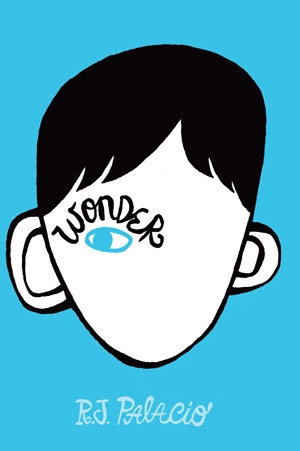
Wonder

Synopsis
Auggie has a rare craniofacial abnormality. ("I won't describe what I look like," he writes. "Whatever you're thinking, it's probably worse.") He's attending public school for the first time in fifth grade and he seems to bring out the very best and the very worst in some of his classmates.

My thoughts
When I checked this book out from the library, one of my friends spotted it in my pile and told me she'd loved it. The librarian who checked me out told me that the library had eight copies of the book and they were all always checked out (I'd snagged the last one off the shelf). Apparently that's pretty remarkable for a YA novel that was published more than a year ago (and that isn't Harry Potter). And now having read it, I'd say Wonder lives up to the hype.

Auggie is a rare gem of a character with an indomitable spirit and a can-do attitude. He's been homeschooled because he's had so many medical issues, and he's initially reluctant to attend school. People have gaped at him his entire life, but that doesn't mean he's used to it or somehow immune to it. His classmates react much as he expects them to—kids say insensitive things (whether they mean to or not) and some of them won't sit by him. But Auggie does manage to make a few friends who overlook his unconventional looks and genuinely like him for his sense of humor and intelligence.

R.J. Palacio does a good job writing from the tween state of mind. It's a really ugly stew of exerting and succumbing to peer pressure, attempting to forge your own identity, and learning to figure out right from wrong when there's not a clear choice. In their own ways, Auggie's friends Summer and Jack go out of their way to befriend Auggie when the prevailing attitude is to shun him, which takes an uncommon mixture of strength and self-confidence. There's a herd mentality in middle school that makes it extremely difficult to be your own person, and it's no surprise that two out of the three kids who act as Auggie's welcoming committee at the beginning of the school year drop him as soon as they can.

One of them is Julian, the child villain of Wonder. Palacio shifts the blame to Julian's parents for raising him to be the inconsiderate little monster he is. He simply follows their example. The scary thing is that I know people who are an awful lot like them. Like Julian's parents, they're French and they named one of their kids Julian. But they're also selfish, self-absorbed people who feel that if a situation inconveniences them or makes them uncomfortable, then others must make everything "right" for them.

The only problem with the book is that everything gets tied up a little too neatly. As much as I reveled in Auggie's triumph over his bullies and his peers' whole-hearted acceptance of him at the end of the book, his story probably wouldn't have ended that happily or that decisively in real life. It was a little disappointing for a book that had had such an authentic voice from the beginning, but it's a YA novel—best to savor the warm, fuzzy feeling it leaves you with.

Bottom line
Wonder has a wonderful feel-good message and I can see why so many schools are making it required reading. I'll keep an eye out for Palacio's next book, too.

Fine print
Wonder, by R.J. Palacio
Genre: YA fiction
Photo from Goodreads
I borrowed this book from the library.

Thursday, May 1, 2014

Fast Food Nation

Synopsis
Fast food has revolutionized the way Americans eat and work—and not in a good way.

My thoughts
Is it bad that more than anything else I just wanted to eat the fries on the cover?

There was a lot of buzz around this book when it was first published 14 years ago, and I think I simply came too late to the party to be outraged by this book. The indictments of the fast food industry seem stale now. Big business discourages unions?! Well ... duh. Fast food chains use unskilled teenage workers?! Have you ever been to a McDonald's? They market their evil, anti-nutrition agenda directly to innocent, unsuspecting children?! Yeah, Happy Meals were certainly a part of my all-American childhood and I turned out okay.

Fourteen years is a long time and the world is a different place now—perhaps in part because of this book. There's a trend toward healthy fast food and away from putting Burger Kings in schools. Small, independent farms are certainly still an endangered species, but it's become trendy to eat locally raised food that comes directly from the source. If this book contributed to the recent focus on healthy eating and increased physical activity, especially for children, then I'm glad people have taken Eric Schlosser's message to heart. And Schlosser does raise some very important points about workplace safety and food safety that have not been addressed. Government oversight of the way our food is raised, prepared, and sold is hopelessly underfunded and ineffective. But I can't raise my own food and I have to eat something. So I will simply continue to do what I've always done—keeping my kitchen clean, washing my hands frequently, washing fruits and veggies carefully, and limiting the utensils that come into contact with raw meat. This book didn't scare me away from fast food, either. I don't eat it very often—just a few times a year—and that won't change.

Something about the way the book was written rubbed me the wrong way. The tone was very sensational—look at the downtrodden fast food worker! the victim of horrific food poisoning! the immigrant working in perilous conditions in a meat packing plant!—yet I was unable to connect to any of them emotionally. And that meant I wasn't able to get all worked up over the issues that were raised in the book. This was a heavily researched product, but I felt at times that Schlosser picked and chose his data and stats to make his conclusions seem more damning.

Bottom line
Underwhelming.

Fine print
Fast Food Nation, by Eric Schlosser
Genre: current events
Photo from Goodreads
I owned this book.

Tuesday, March 11, 2014

The Big Short

Synopsis
A few savvy investors realized that they could potentially make a lot of money by shorting subprime mortgages.

My thoughts
I don't have a background in finance, but Michael Lewis makes a very complicated topic easy and entertaining for laymen to follow. I read this as a follow-up to Lewis's Boomerang, and both have whetted my interest in other books on the financial meltdown. I'm a bit late on this—after all, the market crashed in fall 2008. But the fact that it was so long ago gives me some added perspective. I know what happens next, even if my memories of the collapse of Lehman Brothers and the ensuing chaos are a little hazy. The real treat of this book is getting into the meat of what happened before all hell broke loose.

Lewis has become one of my favorite non-fiction writers, and it's because of the way he can take boring, complicated topics and make them relatable and funny. He does this by writing about the eccentric men who independently clued into the impending crisis. He gives you someone to root for—if not an everyman, then an underdog. It's not a blow-by-blow account from the financial institutions' point of view, but it's interesting to read about the people who accurately predicted the crisis, especially since some of them were denounced as crazy or were not taken seriously before it happened.

Looking back, it's easy to wonder who thought the doomed financial model was a good idea, but Lewis reminds us that it was so large and complex that it was hard to see the whole big picture. It's also scary that—apparently—no one broke any laws. Since 2008, there has been some legislative action (in the form of Dodd-Frank), but there hasn't been much else—or much demand for it. So there are some new safeguards in place, but they are limited and they still leave Wall Street to police itself and show restraint.

One note not about the book itself: I read this on my brand new Kindle and liked it quite a bit. I was annoyed that I was constantly turning pages, but I did like how light it felt in my hands (and in my purse). I used the Kindle Owners' Lending Library to borrow the book and I'd definitely do that again.

Bottom line
A compulsively readable account of the spectacular failure of the financial system.

Fine print
The Big Short, by Michael Lewis
Genre: non-fiction, current events, finance
Photo from Goodreads
I borrowed this book from the Kindle Owners' Lending Library.